The resources and links listed on this page will enhance your nature study lessons for the Australian Nature Study Guide | Volume Three.
Book resources and links have been updated since this volume was published in 2018. Should you encounter an expired link, please let us know, and we’ll fix it.
Table of Contents
NOTEBOOK PAGES FOR VOLUME THREE ~ WINTER/SPRING
Use the notebooking pages below to capture your nature adventures. Keep them in a file or paste them into a nature notebook or journal. There are three levels: Preschool, Lower Primary, and Upper Primary.
Winter Tree Study
Further Exploring
Exploring Creation with Botany by Fulbright.
- Stems, pg. 117
- Woody and Herbaceous Stems, pg. 118
- Tree Growth, pg. 128
- Twig Anatomy, pg. 129
- Estimating the Height of a Tree, pg. 130
- Growing Outward, pg. 131
- Layers in a Tree Trunk, pg. 131
Keeping a Nature Journal by Clare Walker Leslie
- The Winter Journal, pg. 89
- Drawing Winter Deciduous Trees, pg. 100
Nature Anatomy by Julia Rothman
- Anatomy of a Deciduous Tree, pg. 99
- Tree Shapes, pg. 98
- Anatomy of a Trunk, pg. 100
- Dendrochronology, pg. 101
- Beautiful Bark, pg. 112
Stems by Steffi Cavell Clarke
Related Internet Links
Literature Jaunt
- Tree in a Trail by Holling Clancy Holling
- The Tree by Neal Layton
- A Stick is an Excellent Thing by Marilyn Singer
- Little Acorn: Nature Stories
- The Oak Inside the Acorn by Max Lucado
Literature Jaunt
Tree in a Trail by Holling Clancy Holling
The Tree by Neal Layton
A Stick is an Excellent Thing by Marilyn Singer
Little Acorn: Nature Stories
The Oak Inside the Acorn by Max Lucado
Poetry Picnic
A Stick is an Excellent Thing by Marilyn Singer
A Hymn
Trees of the Field by Stuart Dauermann lyrics and music.
Trees Will Clap by Crossing Music
Picture Study
Lone Tree by Graham Gercken
Digging Deeper
Young Students:
- Explore a tree blindfolded by touching, feeling and smelling it. Walk away, then spin around and find the tree you explored using your senses.
- Remove your socks and shoes and be led to a selected tree for investigations blindfolded. You’ll use your toes to explore the tree and describe the sensations you’re feeling. What is the tree’s texture? Is it rough or smooth? Is it narrow or broad? Does it tickle?
- Use the twig anatomy notebook page to explore twigs.
- Use the tree notebook page to record your observations.
- Paint twigs to create a twig bouquet in a jar.
- Make a stick man using twigs.
- Paint a silhouette of a winter tree in your journal using brown or black paint.
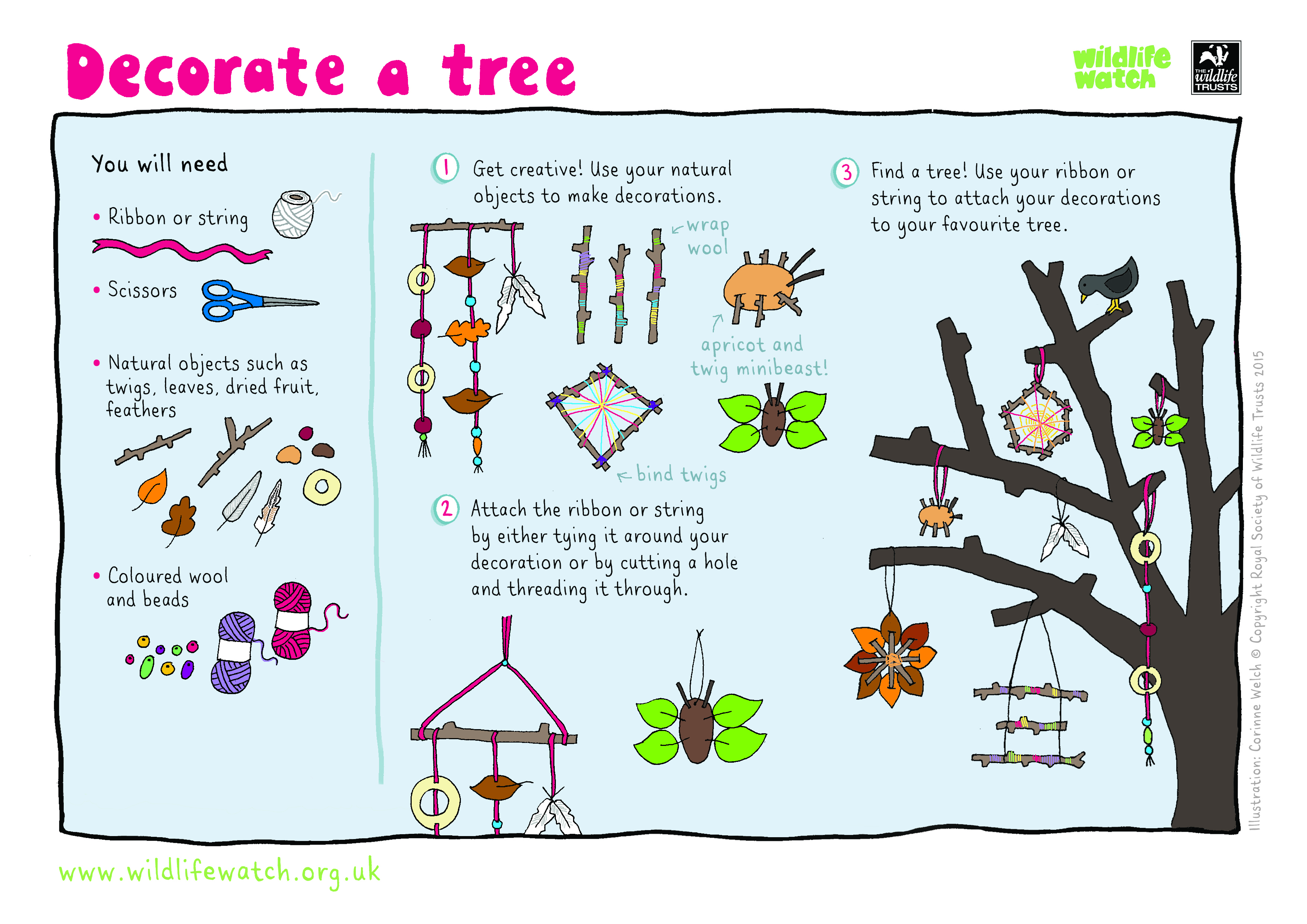
- Decorate a tree using these ideas from Wildlife Watch.
Older Students
- Use the twig anatomy notebook page to explore twigs.
- Note your observations on the tree notebook page.
- Alternately, sketch the anatomy of a twig and its buds in your nature journal and write what you notice and wonder about them.
- Study the stump or log of a tree. Can you tell which is the heartwood and the sapwood? Observe the growth rings. Notice the different colours of wood within a ring. Why are some rings wider than others? How old was the tree?
- Draw a tree stump in perspective with this tutorial.
- Investigate xylem with this experiment:
- Fill a glass halfway with water and add a teaspoon of food colouring.
- Place a stalk of celery into the glass and leave it there for a few days. Observe the changes.
- Remove the celery stalk from the water and cut the stalk in half horizontally. Observe the parts which have changed colour. What are these pipes called and what do they do for the plant?
- Sketch your experiment and record your observations.
- Make a bark rubbing with clay and plaster of paris to hang on your wall:
- Press a chunk of clay on to the bark. Press it firmly into the fissures.
- Lift the clay. Be careful not to alter the impression.
- Build a collar around the impression to hold the plaster of paris in, sealing all gaps.
- Brush the impression with sunflower oil. This will help the plaster come away without sticking.
- Make a mixture of plaster of paris and pour it into the mould. Tap it to release any air bubbles. Insert a loop made of wire into the plaster before it dries. This will provide a hook to hang up your bark impression.
- When the plaster has set, remove it from the mould, wash it in warm water and paint it with natural colours.
- Create a winter tree using oil pastels.
- Research the use of bark and wood in Aboriginal lives. Create a poster to present your project.
- Explore how trees eat, drink and breathe with this chart.
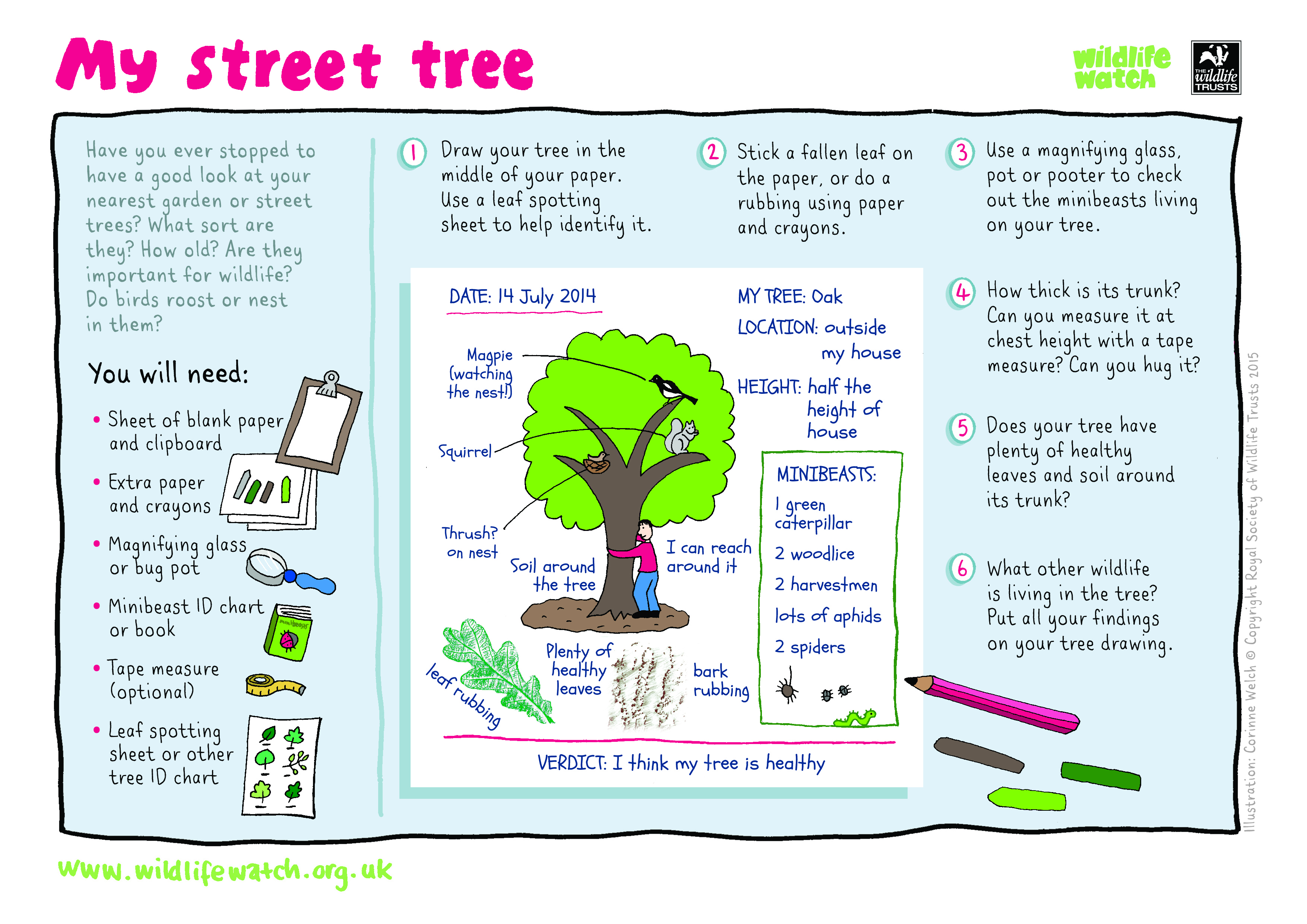
- Investigate a street tree using this chart from Wildlife Watch.
Oldest Students
- Australia has few native deciduous trees. Research the reason for this and share it with your family.
- Measure the distances between the terminal bud and previous circular scars on twigs to determine how well the tree has grown in the last few years. Show the results on a bar graph.
- Use the twig anatomy notebook page to explore twigs.
- Note your winter tree observations on the tree notebook page.
- Alternately, sketch the tree and note your observations inside your field journal.
- Write a report with diagrams explaining the structure of the vascular cambium.
- Draw an anatomically correct twig with this tutorial.
- Learn to draw basic tree shapes using this tutorial.
- Use Clare Walker Leslie’s Guide to Sketching Trees to challenge your drawing skills.
Banksias
Further Exploring
Amazing Facts about Australian Native Plants by Steve Parish
- Banksias, pg. 10-11
Wild Food Plants of Australia by Tim Low
- Banksias, pg. 142
Field Guide to Banksias by Ivan Holliday and Geoffrey Watton
The Banksias by Celia Rosser
The Banksia Book by A. S. George
Nature Crafts for Aussie Kids by Kate Hubmayer
Related Internet Links
Banksias | Australian National Herbarium
Nectar Giving Shrubs | Backyard Buddies
Literature Jaunt
Little Ragged Blossom by May Gibbs
Poetry Picnic
Ode to Banksia Floribunda by John Anderson
A Song
Picture Study
Banksia serrata by John Frederick Miller
Digging Deeper
Young Students:
- Make a banksia man by using a cone for the body, small gum nuts for eyes and a dried, open protea flower cone as a hat.
- Explore the Banksia plants with your senses. Describe what you see. What does it feel like? Does the flower have a taste? What does it remind you of? Does it have a scent? What sounds can you hear around the plant? This will give you an idea about which animals might be pollinating the plant.
- Use the Banksia notebook page to record your observations. Alternatively, you can record your plants information on the Bush Tucker notebook page in the Summer/Autumn Nature Study Guide Vol 1.
- Take photos of all the parts of a Banksia plant and paste it into your nature journal.
- Make Nectar Blossom Cordial by soaking nectar laden flowers in water overnight. While the nectar sweetens the water, place it inside the refrigerator. Drain the water carefully and enjoy it as a refreshing drink. The Banksia Nectar Blossom drink if loaded with minerals and vitamin C.
- Plant a Banksia in your backyard to encourage honeyeaters to visit.
Older Students:
- Simulate bushfire conditions to release the Banksia seed from the cone by placing them into an oven at 120-140 degree Celsius for about an hour. The follicles should open and release the seed. Pay attention to how it happened.
- Take the seed outside and let it fall to the ground. Pay attention to how it moves; is it spinning or floating? Discuss the reason for the seeds movement.
- Use the Banksia notebook page to record your investigations during your nature walk. Alternatively, you can record your plants information on the Bush Tucker notebook page in the Summer/Autumn Nature Study Guide Vol 1.
- Create a food web surrounding the ecosystem of a Banksia plant or a flowering native plant in your locality.
- Watch the time lapse drawing of Banksias and Honeyeaters.
- Research how Banksia cones are used to make interesting objects like pens, bowls, salt and pepper shakers, jewellery, candle holders and vases. Make a list.
- Investigate other uses Aboriginals had for the Banksia cones like using them as candles. How would they do this? Display your research on a Power Point display. Banksia cones were also used as a hairbrush. Use one to comb your hair.
Oldest Students:
- Investigate the science in how smoke encourages seeds to sprout. Alternatively, Research how bushfires encourage banksias to open their follicles. Share this information with your family.
- Sketch a botanical diagram like this one into your nature journal.
- Draw Banksia flowers and cones in its various stages of life in your field journal. Emphasize line, shape, textures and tonal patterns to outline your subject. Write down the information you gathered on your Banksia nature walk. Add any questions you might have to your page.
- Research and write a report on the factors which are threatening the survival of the Banksia like land clearing, fungal and disease attacks. Include solutions for these problems.
- Create a database listing the botanical name, common name, distribution, physical characteristics and conservation status of the Banksia plants in your area. Alternatively, create the same database for nectar producing shrubs.
Platypus
Further Exploring
Junior Encyclopedia of Australian Wildlife by Steve Parish
Living with Platypus: A Practical Guide to the Conservation of a Very Special Australian by GA Williams and M Serena
Platypus: The Extraordinary Story of How A Curious Creature Baffled the World by Ann Moyal
The Book of Australian Animals by Charles Hope
Amazing Australian Animals by Barry Silkstone
Related Internet Links
Platypus: The Mystery Mammal | Answers in Genesis
The Platypus | Answers in Genesis
Platypus | National Geographic
Fun Platypus Facts for Kids | Science Kids
Platypus Parts | National Geographic Video
World’s Deadliest | National Geographic Video
Platypus | All Things Animal TV
I’m a P P P Platypus | Steve Axtell
Literature Jaunt
I’m a Platypus by Moment Johnson
Shy the Platypus by Leslie Rees
Percy the Peaceful Platypus by Jill Morris
Platypus by Sue Whiting and Mark Jackson
Paddles the Platypus by Eva-Marie Welsh
A Platypus, Probably by Sneed B. Collard
Poetry Picnic
Old Man Platypus by Banjo Paterson
A Song:
It’s Designed to Do by Buddy Davies
Picture Study
Digging Deeper
Young Students:
- Use the Monotreme notebook page to draw a platypus.
- Draw an observation you made inside your field journal while on your winter pond nature walk.
- Make a paper plate platypus.
- Create Perry the Platypus | Toilet Roll Craft
- Take the water temperature of the pond and discuss the difference of temperatures through the seasons.
- Examine the 20c coin for the platypus.
- Take a photograph of your winter pond to paste in your nature journal.
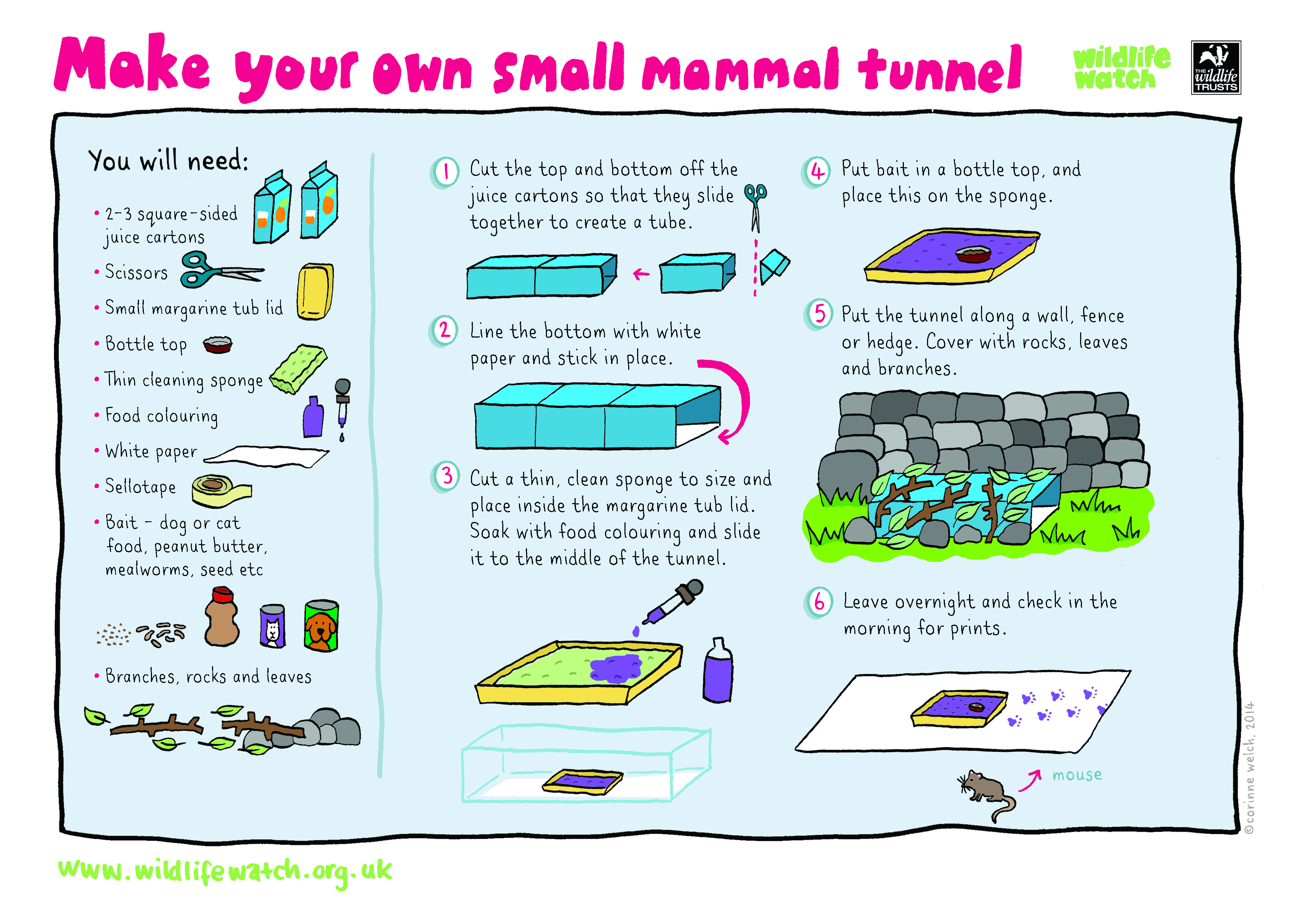
- Make your own mammal tunnel with Wildlife Watch.
Older Students:
- Choose one of many ponding activities from the Ponding: Activities for your local pond, lake or puddle book by Wilhelmina Wallis and available at Gould League.
- Use the Winter Pond notebook page to record your pond observations.
- Record an observation you made in your field journal by drawing a sketch of your object. Label it and make a few notes about what you noticed and wondered. Write down your questions to research.
- Make a platypus bookmarker to give away to a friend. Write a letter about the interesting things you learned to send with it.
- Draw a platypus. Label it’s anatomy. List interesting platypus facts.
- Compare your winter pond notes with your summer and autumn notes. Discuss the differences you noticed with a family member.
- Compare the platypus to other warm-blooded mammals. Discuss the differences between them.
Oldest Students:
- Make a field journal entry of an observation you made during the pond nature walk by:
- Drawing a zoomed in image of the object. Add an x-ray view to the page.
- Including observational notes like it’s behaviour, colours, shapes, patterns and connections.
- Jotting down your questions to research.
- Use the Winter Pond notebook page to record your nature walk observations.
- Explain electro-sensitivity in animals to a friend.
- Sketch a platypus. Label it’s anatomy and list interesting platypus facts.
- Make an origami platypus.
- Compare your winter pond notes with your summer and autumn notes. Discuss the differences you noticed with a family member.
- Plan and share a speech on “The Exceptional Platypus.” Prepare to astonish your audience with the unusual facts you’ve learned.
- Research the reactions and thoughts of people in the 18th century when they first encountered the platypus which has a bill like a duck, a beaver tail, webbed otter feet, bear hair, reptile claws, lays turtle eggs, and has poison like a snake. Write a persuasive essay convincing the cynics of the platypus’s unique design.
Echidna
Notebook Pages
Further Exploring
Junior Encyclopedia of Australian Wildlife by Kylie Currie
- Spiky Wanderer, pg. 20.
Animals of Asia and Australia by Tom Jackson
Related Internet Links
Echidna Facts of Kids | Kiddle
Literature Jaunt
Big Mob Echidnas by Margaret James and Marjorie Nyunga Williams
Get the Echidna by Margaret James
Rainforest Lullaby by Sally Odgers and Lisa Stewart
Spikey Echidna by Steve Parish
Scaly-tailed Possum and Echidna by Cathy Goonack
Where’s the Spikey Echidna by Lesley Dewar
Poetry Picnic
Ellie the Echidna by Alexander Dudley
Picture Study
Digging Deeper
Young Students:
- Listen to Spike the Echidna sing ‘I Love Ants’ here.
- Create an echidna ice-cream cake like this.
- Use natural materials like banksia cones to design your own echidna.
- Colour in the echidna notebook page.
Older Students:
- Listen to Platypus and Echidna: Egg-laying Mammals here.
- Take a look at this ball of spikes at Brave Wilderness here.
- Use modelling clay or play dough to create an echidna. Use toothpicks or rainbow matchsticks to make spikey spines.
- Record your observations during your nature walk in your nature journal or use the notebook page provided.
Oldest Students:
- Research how scientists make sense of the animal kingdom by naming and grouping species. Start here.
- Discuss the characteristics that classify the echidna as an egg-laying mammal.
- Research where Sir David’s long-beaked echidna is found and how it got its name.
- Record your observations during your nature walk in your nature journal or use the notebook page provided.
- Meet Yella the Echidna here.
Orchids
Further Exploring
A Complete Guide to Native Orchids of Australia by David L. Jones and B. Ag. Sc.Dip.Hort.
Little Book of Australian Orchids by National Library of Australia
Flower by Andrew Zuckerman
Exploring Creation with Botany by Fulbright.
- Pollination, pg.49
- Animal Pollination, pg. 50
- Creation Confirmation, pg. 52
- A Bee’s Landing Pad, pg. 53-55
- Nectar Guides, pg. 57
- Getting the Pollen, pg. 59
- Flower Pollination Project, pg. 60
Related Internet Links
Orchids: The Masters of Lying, Stealing and Cheating
Hunting Australian Native Orchids
Small Miracles | Gardening Australia
An Orchid Enthusiast | Gardening Australia
A Gallery of Australian Orchids | Australian Geographic
Literature Jaunt
A Hymn
Blessed are the Pure in Heart by Summit Christian Academy
Picture Study
Digging Deeper
Young Students:
- Sketch an orchid on the orchid notebook page provided.
- Paste a photograph of an orchid you found inside your field journal and label it.
- Visit an Orchid Show.
- Some orchids look like animals or birds, like the Duck Orchids. Design your own orchid that has the appearance of a living creature.
Older Students:
- Draw an orchid in your field journal and label it’s anatomy. Write down the observations you made on the nature walk. Include interesting orchid facts.
- Use the orchid notebook page to record your observations. Zoom in and sketch a part of the plant you find interesting. Add your observations and any questions you may have.
- Watch this time-lapse drawing of an orchid using watercolour pencils.
- Design your own orchid. Will it have the appearance of a bird like the owl orchid or duck orchid? Consider the way your orchid will be pollinated and who the pollinator will be and explain the pollination process to your family.
- Draw an Orchid Treasure Map by marking the locations of orchids you find on the orchid hunt. Create names for these places and add landforms to help locate the sight on a future walk.
- Write a letter from the orchid to the insect explaining how it’s survival is dependent upon them to help pollinate and generate another orchid cycle, and without them, the orchid species would become extinct.
Oldest Students:
- The vanilla flavour we find in ice cream comes from an orchid. Vanilla is one of the best known and widely used flavours which is extracted from the pod of Vanilla planifolia. Investigate the process of extracting the essence from the pod and all its uses.
- Write an essay explaining the different types of symbiotic relationships and their developments. Draw illustrations to explain the process.
- Record your observations on the Orchid notebook page.
- Explore the lifecycle of an orchid and draw a diagram showing the process.
- Paint orchids with watercolours using this tutorial.
Molluscs / Gastropods
Further Exploring
Why do Snails and Other Animals Have Shells?
The Wonderland of Nature by Nuri Mass
- Slugs and Snails, pg. 123
- What are Shells, pg. 186
- Shells Made of One Piece, pg. 189-196
- Shells Like Butterflies and Fans, pg. 197-203
- Roly- Poly Molluscs, pg. 204
Exploring Creation with Zoology 3 by Fulbright
- Slugs and Snails, pg. 249
- Special Slime, pg. 250
- Gastropod Anatomy, pg. 251
- Snail Stowaways, pg. 252
Related Internet Links
Molluscs: Educational Video for Kids
Snails, Slugs and Slime by SciShow Kids
Literature Jaunt
The Snail and the Whale by Julia Donaldson
Snail and Turtle Books by Stephen Michael King
Sophie’s Snail by Dick King Smith
Poetry Picnic
A Hymn
A Shelter in the Time of Storm – Vernon J Charlesworth lyrics and music.
Picture Study
Chambered Nautilus by Rafael Araujo
Digging Deeper
Young Students:
- Gently capture a snail, place it inside a glass jar and watch how it moves its foot.
- Make a playdough snail. Recipe here.
- Roll a long snake, then curl the end up to make a shell. Pinch the front end to make the ‘eyes.’
- Make a snail sandwich.
- Colour a snail picture.
- Learn Herbert the Snail’s song by Music Machine Patience Song.
Older Students:
- Make a snail snack.
- Collect snails and have a snail race!
- Research the kind of snails you have in your area.
- Start a shell collection. Use a shell guide to help identify your collection.
- Fill out the Mollusc notebook page.
- Draw and label the anatomy of a snail.
Oldest Students:
- The Golden Ratio is a mathematic spiral that you can see in Nature. It is beautifully designed and can be seen in the shells of the gastropods. Research the Golden Ratio. Find examples in Nature and Art.
- Start a shell collection. Identify and label the shells you find.
- Complete the Mollusc notebook page.
- Write a report on the Cone Shells found in Australian Waters.
- Create a piece of art work using the Golden Ratio. See Rafael Araujo’s work to inspire you.
Powerful Owl
Further Exploring
Amazing Facts About Australian Birds by Steve Parish
Junior Encyclopedia of Australian Wildlife by Steve Parish
100 Facts About Birds of Prey by Miles Kelly
Birds of Prey by Paul D. Frost
Related Internet Links
Powerful Owl | Birds in Backyards
Powerful Owl | Australian Museum
Powerful Owl Profile | Birdlife Australia
Super Hearing Helps Owls Hunt | National Geographic Wild
How Does an Owl’s Hearing Work? | BBC
Literature Jaunt
Apollo the Powerful Owl by Gordon Winch
Two Twitter by Ken Gray
Why Do Owls and Other Birds Have Feathers | Read and Learn | Raintree
White Owl, Barn Owl by Nicola Davies
Poetry Picnic
A Song
Picture Study
Digging Deeper
Young Students:
- Learn how an owl flies silently by listening to this video.
- If you found an owl nest, search for owl pellets and dissect one. What animals do you think the owl has eaten?
- Use the night nature walk or Australian bird notebook page to record your observations.
- Create a Bark Owl using a sheet of bark and gum nuts.
- Bake Owl Cupcakes like this.
- Draw an owl with this tutorial.
Older Students:
- Watch this sound experiment between a dove, hawk and owl, and then watch this one.
- Use the night bush walk or Australian bird notebook page to record your observations.
- Make a journal entry of an observation you enjoyed the most during your night bush walk. Draw a sketch and write down your thoughts and feelings.
- Purchase an owl pellet to dissect. Once you’ve had fun poking around in owl puke, reconstruct the animals skeletons.
- Create an owl project on poster board. Include facts about the owls immovable eyes, how it’s able to turn its head 270 degrees and its super hearing senses.
- Draw and colour this fun owl picture.
- Oldest Students:
- Investigate and explain how an owl is able to turn its head 270 degrees without snapping it off. How is it different to a humans neck?
- Research and write a report explaining the super senses of an owl.
- Use the night bush walk or Australian bird notebook pages to record your observations.
- Make a journal entry of an observation made during your night bush walk. What did you notice and wonder while outdoors?
- Use recycled items like bottle tops and forks to create an Owl Wood Slice.
- Sketch an owl in your nature journal and jot down interesting facts you’ve learned about them.
- Purchase an owl pellet to dissect. Once you’ve had fun poking around in owl puke, reconstruct the animals skeletons.
Wildflowers
Further Exploring
Amazing Facts about Australian Native Plants by Cathy Hope and Steve Parish
Key Guide to Australian Wildflowers by Leonard Cronin
Australian Native Plants by Vincent Serventy
Australian Wildflowers by Michael Morcombe
Wildflowers of the South East by Elizabeth Conabere and J. Ros. Garnet
Flower by Andrew Zuckerman
Discovering the Flowers of Western Australia by Margaret Pieroni
The Wonderland of Nature by Nuri Mass
➢ Flowers – and the Clever Things They Do, pg. 158-171
Exploring Creation with Botany by Fulbright
➢ Flowers, pg. 35
➢ Even the Flowers Obey, pg. 37
➢ Making Seeds, pg. 37
➢ Flower Dissection, pg. 38
➢ What Do You Remember, pg. 39
➢ Flower Families, pg. 41
Zoom: The Invisible World of Plants by Camilla De La Bedoyere
1000 Things You Should Know About Plants by Miles Kelly Publishing
Related Internet Links
Flora of Australia | Wikipedia
The Wildflowers of Western Australia | Australian Geographic
Australian Wildflowers | Western Australia Now and Then
WA Wildflowers | Burkes Backyard
Native Garden in Perth | Burkes Backyard
Literature Jaunt
Wildflower: The Life and Art of Ellis Rowan by Cassey Liberman
Sidewalk Flowers by JonArno Lawson
Flowers are Calling by Rita Gray
Miss Rumphius by Barbara Cooney
Boronia Babies by May Gibbs
Flannel Flowers and Other Bush Babies by May Gibbs Read Aloud
A Gospel of Wildflowers by Anthony Footit
Poetry Picnic
Wildflowers of Australia by Mrs C.J. Carleton
A Hymn
Consider the Lilies by Patty Green lyrics and music.
Picture Study
Flowers and Salmon Gum Trees of the Northern Territory by Margaret Preston
Digging Deeper
Young Students:
- Create a wildflower and butterfly using toilet paper rolls.
- Sing a Song of Flowers here.
- Plant wildflowers in your backyard. The bees and butterflies will be grateful to you for thinking of them.
- Draw a daisy like this one.
- Use the wildflower notebook page to draw your wildflower.
- Discuss and draw the lifecycle of a plant.
Older Students:
- Plant wildflowers in your backyard for the bees, butterflies and birds.
- Us the wildflower notebook page to sketch and record your observations of wildflowers.
- Draw a scenery of flowers like this.
- Compare woody plants to non woody plants. Sketch a picture of both in your journal and write down the differences between them.
- Create a collage of the park you visited using pictures from magazines of foliage and trees. Show the diversity and density of the overstory and the understory.
- While out on the wildflower walk, place a hoop or section off a 1m x 1m block of interesting bushland with pegs and string. Draw a table with three columns named:
o Common Plant Name
o Sketch
o Tally
Name the plants, sketch them and count how many are within your square metre. Discuss the density and diversity of the plants in your table. - Choose one wildflower to study and sketch it in your field journal. Consider the following:
o What is the flower shape? Is it:
▪ Open?
▪ Composite?
▪ Tubular?
▪ Cylindrical flower head like a Callistemon?
▪ Cupped?
▪ Orchid?
▪ Pea?
▪ Globular flowerhead like a Billy Button?
▪ Spidery flowerhead like a Grevillia?
o What are the flower arrangements? Is it:
▪ Spiked?
▪ Raceme?
▪ Panicle?
o How many petals does the flower have?
o What is the colour of the flower, leaves and stem?
o What are the leaf arrangements? Are they:
▪ Opposite
▪ Decussate
▪ Alternate
▪ Whorled?
o What are the leaf shapes?
o What are the leaf margins?
o What is the leaf venation? - Draw the anatomy of a flower like this one.
Oldest Students:
- Paint wildflowers in watercolour.
- Sketch a scientific illustration of a wildflower you find on the nature walk inside your field journal. John Muir Laws shows you how here.
- Use the wildflower notebook page to sketch and record your observations of wildflowers. Use the circle to zoom in on a plant part which interests you.
- Map plants in their environment along a transect line using this resource to guide you.
- Research Walter Bitterlichs invention of a gauge that is able to measure the density of trees within forests.
- Carefully dissect a flower and examine the plant parts.
- Using the photographs you took of the wildflower landscapes, observe and discuss the following:
o How many colours can you see in the photograph?
o What shapes can you see? Are there any cone shaped trees?
o Identify the overstory, middle and understory of the vegetation.
o How many different plants can you find?
o Which is the most dominant species in each layer of vegetation?
o Can you name the plants in the photo?
o What kind of animals, birds and insects live here?
o Is there more land or sky in the picture? Why?
o Can you see bare soil? Why?
o Compare this photograph with other landscape pictures. What is different and what is the same? - Make a simple sketch of the bushland or forests you explored showing the overstory, middle and understory of the vegetation and make a list of the dominant plant species in each layer. Using the above Vegetation Survey Table, decide on the plant density percentage within each layer.
- Start a wildflower calendar by creating a simple table of the plants you notice flowering and recording the date. You can add a simple sketch or a photograph of each flowering wildflower throughout the year.
Nesting Birds
Exploring Creation with Zoology 1 by Fulbright
➢ Nesting, pg. 73-74
➢ Types of Nests, pg. 75
➢ Weavers and No Nesters, pg. 76
➢ Ground and Mound Nesters, pg. 78
➢ Earth-Hole Nesters, pg. 79
➢ Cavity Nesters, pg. 79
➢ Platform Nesters, pg. 81
➢ Cup Nesters, pg. 82
➢ Adherent Nesters, pg. 83
Related Internet Links
The Secret Life of Bird Nests | Kids Nature Video
The Incubator Bird: Nest Engineers | Answers in Genesis
Australian Bowerbird | BBC
Raising Willie
Purple Swamphen Nesting
Beach Nesting Birds | Bird Life Australia
Literature Jaunt
Bird Builds a Nest by Martin Jenkins
Birds Make Nests by Michael Garland
A Nest is Noisy by Dianna Hutts Aston
The Best Nest by P. D. Eastman Read Aloud
Poetry Picnic
The Firetail Finches by C.J. Dennis
A Song
His Eye is on the Sparrow sung by Selah.
Picture Study
Nesting Australian Magpies by John Gould

Digging Deeper
Young Students:
- Listen to the Green Grass Grows All Around Song.
- Create a paper plate bird nest like this.
- Build a nest using natural materials like grass, string, twigs and mud, or create a nest using cardboard boxes for yourself to play in.
- Use the bird notebook page to draw a nest and record your observations.
- Help birds build their nests by providing materials for them to use in your backyard like hay, peat moss, feathers, hair, yarn, ravelled hessian and sheep fleece. Leave twigs, leaves, lawn cuttings, bark and pine needles in the yard for the birds to use. Keep checking your nesting stock and notice which materials the birds are using most.
- Discuss how you can keep safe from swooping birds this nesting season. Start here.
- Start a collection of abandoned nests. Examine the materials used and match it to its creator.
Older Students:
- Listen to the Rattling Bog Song.
- Research how you can stay safe from aggressive swooping birds this nesting season. Discuss what you’ve learned with your family and create a ‘Plan of Action’ should you have an encounter with the protective birds.
- Use the bird notebook page to record your nature walk observations.
- Sketch the nests and eggs of various birds inside your field journal. What kind of nests are they? Are they burrows, cavity, platforms, cups or adherent nests?
- Observe the nesting birds in your locality and create a Nest Map. Look here for inspiration.
- Play the Kookaburra Kookaburra Card Game.
Oldest Students:
- Sketch the birds, nests and eggs you’ve observed on your nature walk. A good bird guide will have an image of the eggs to copy inside your field journal. Jot down your observations and questions. Research the birds breeding and nesting behaviours and add these facts to your page. Have a look here for inspiration.
- Use the bird notebook page to record your observations.
- Choose one bird species to observe this nesting season. Take photographs. Watch them closely over the weeks as they court, incubate eggs and the hatchlings emerge to eventually leaving the nest. Time how long they incubate the eggs for and how long the hatchlings stay in the nest. Which parent feeds them? Compile a list of questions and set out to find the answers by carefully watching the birds. Compile your investigation into a Power Point Project.
- Research and design a project on coastal shore nesting birds like the Hooded Plover.
- Migratory birds are returning. Do you notice any in your locality that were absent through the winter months? Compile a list of migratory birds for your area. Take it further by creating a project of spring returning migratory birds and their behaviour and nesting territories.
- Build a bird box. Start here.
- Paint a birds nest.
Vernal Equinox
Further Exploring
Charlotte Mason’s Elementary Geography by Charlotte Mason and revised by Sandi Queen
➢ Lesson 11-14.
Note: Although written for the northern hemisphere, the lessons are simple and helpful to explain the tilt of the earth on its axis and why we have seasons.
The Universe – From Comets to Constellations by Tom DeRosa and Carolyn Reeves.
Note: This is an Elementary Astronomy Text with student workbook and teacher key. It’s full of hands on activities and fascinating information of the universe. It is produced by Master Books and is a Christian Resource.
Exploring Creation with Astronomy by Fulbright
➢ Stars and Galaxies, pg. 142-156.
Philip’s Planisphere – for latitude 35º south.
Spring: Seasons in Australia by Greg Pyers
Free Apps for Phone or Tablet:
Night Sky for Apple iOS devices
Sky Map for Android devices
Related Internet Links
Seasons and the Sun: Crash Course Kids 11.1
Habitable Planet – Answers in Genesis
The following are fascinating articles for older student and adults:
Constellations: Legacy of the Dispersion from Babel
Britannica Article
Australian Aboriginal Astronomy
Literature Jaunt
Lullaby and Goodnight by P. Crumble.
Picnic by John Burningham.
Carry On, Mr Bowditch by Jean Lee Latham – for the older students.
Finding Wonders: Three Girls Who Changed Science by Jeannine Atkins
Goodnight Galaxy by Adam Gamble and Mark Jasper Read Aloud
Poetry Picnic
“When I Heard the Learn’d Astronomer.” by Walt Witman
The poem is read Here.
A Hymn
The Psalm Project – Psalm 19 ~Chris Heesch lyrics and Music.
Picture Study
Southern Hemisphere star map by Albrecht Durer ( ~1515).
Digging Deeper
Young Students:
- Side walk chalk constellation look here.
- Using a mosaic pin board create your own constellation.
- Make a constellation viewer.
- Draw in your journal your picnic spot.
- Complete a notebook page.
Older Students
- Equinox comes from the word equal. Explore the concept of equa; can you find things in nature which are equal in length? Height? Weight? Record them in your journal.
- Complete the vernal equinox notebook page.
- Make a star map on the ceiling of your room. You can buy glowing stars. (Make sure you have permission from your parents BEFORE you do this!)
- Record sunrise and sunset times. Compare these with the figures you recorded of the autumn equinox and winter solstice.
- Make a shoe box constellation viewer. Instructions here.
- Investigate how a telescope works. Write a report.
Oldest Students:
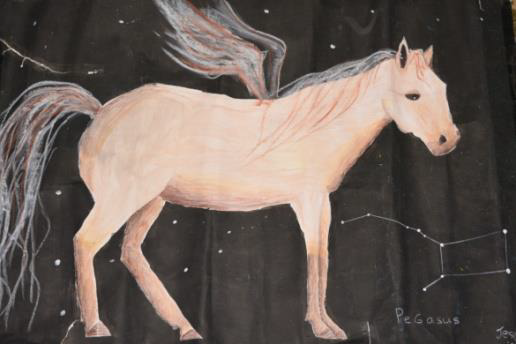
- Using black card create a piece of art of one of the constellations visible in the southern night sky in September. This one of Pegasus was done by Jessica Compton in 2002.
- Research the history of star gazing in the past. Make a timeline of astronomy.
- Find references in the Bible to stars and constellations. Why were the heavens so important to ancient people?
- Record the difference in sunrise and sunset times for this month. Transfer your figures to a graph.
- Record the constellations visible at this time of year in your journal.
Eucalyptus Leaf Beetle
Further Exploring
Backyard Insects | Horne and Crawford
Micro sculpture – Levon Biss. This is an amazing up-close view of lots of different insects.
Christian Liberty Nature Reader – Book 3
➢ All about Beetles, pg. 51-88
Amazing Facts about Australian Insects and Spiders by Steve Parish
➢ Wings in Sheaths, pg. 32
The Wonderland of Nature by Nuri Mass
➢ Beetles – Friends and Foes, pg. 44-50
➢ Bugs – Not Beetles, pg. 51-56
Exploring Creation with Zoology 1 by Fulbright
➢ Beetles, Flies and True Bugs, pg. 183
➢ Beetles Behaviour, pg. 184
➢ Both Beneficial and Pesky, pg. 184-185
➢ Scarab Beetles, pg. 185
Beetles by Shane F. McEvey
Beetles by Claire Llewellyn and Barrie Watts
Beetles and Bugs by Dr Jen Green
Related Internet Links
Eucalyptus Leaf Beetle | Victoria Museum
Leaf Beetle Facts for Kids
Leaf Beetle and Amazing Larvae – You Tube
Pictures of Australian Leaf Beetles Set to Music
Beetle Anatomy
Literature Jaunt
Step Gently Out by Helen Frost
The Bugliest Bug by Carol Diggory Shields
Behold the Beautiful Dung Beetle by Cheryl Bardoe
Poetry Picnic
A Hymn
‘Be Magnified’ by Lynn DeShazo music and lyrics.
Picture Study
Digging Deeper
Young Students:
- Make a paper plate beetle. Look Here for inspiration.
- Draw a beetle on your notebook page or in your journal.
- Go to library and take out books on beetles.
- Make your own beetle puzzle.
➢ Print a colouring page Here or find a picture of a beetle. You could even use a photo of a beetle you find.
➢ Paste it onto cardboard. Old cereal boxes are great.
➢ Cut it into pieces.
➢ Can you put it back together?
Older Students:
- Do an online jigsaw puzzle Here.
- Research the difference between a beetle and a bug. Write a report.
You can start looking for information Here and Here. - Complete the notebook page for this lesson or do a page in your journal.
- Take photos of any beetles you find. Try and identify them. Create a photo log of all the beetles in your backyard.
- In your journal, draw the life cycle of a beetle.
Oldest Students:
- Make a Venn diagram showing the similarities and differences between a beetle and a bug. Example, start researching Here and Here.
- Complete the note book page for this lesson. Pay attention to one part; leg or antennae and do a close-up view of that area.
- If possible, look at a specimen though a microscope. Make a note of what you observe.
- Research the types of leaf beetles and which kinds are considered pests in Australia.